Try the problem
See what you can do with just a blank slate.
ABOUT
Curated problems grounded in foundational ideas.
Practice probability, expectation, games, logic, and strategy to learn structure, not recall. Start with the problem, use hints only when you need them, and review the path after you solve.
See what you can do with just a blank slate.
With support for both numerical and algebraic formats.
Expose one thought at a time so you can get past a block without revealing the whole path.
Read the solution to connect the problem to the underlying idea.
* Revealing a hint or solution step can still leave the problem marked correct, but not flawless; the solution links to the reference section behind the work.
For example:
You roll a fair die twice, what is the probability that both rolls show the same number?
Five light bulbs are initially all off. Every second, one bulb is chosen uniformly at random and flipped. What is the expected time until all five bulbs are off again?
Reference
Intuition doesn’t always require derivation. Editorial notes separate the quick idea from the full argument.
Each reference page points back to related practice, making the map from technique to problem explicit.
Focus on patterns, heuristics, shortcuts, and approximations that help you recognize structure on the fly.
A useful snippet
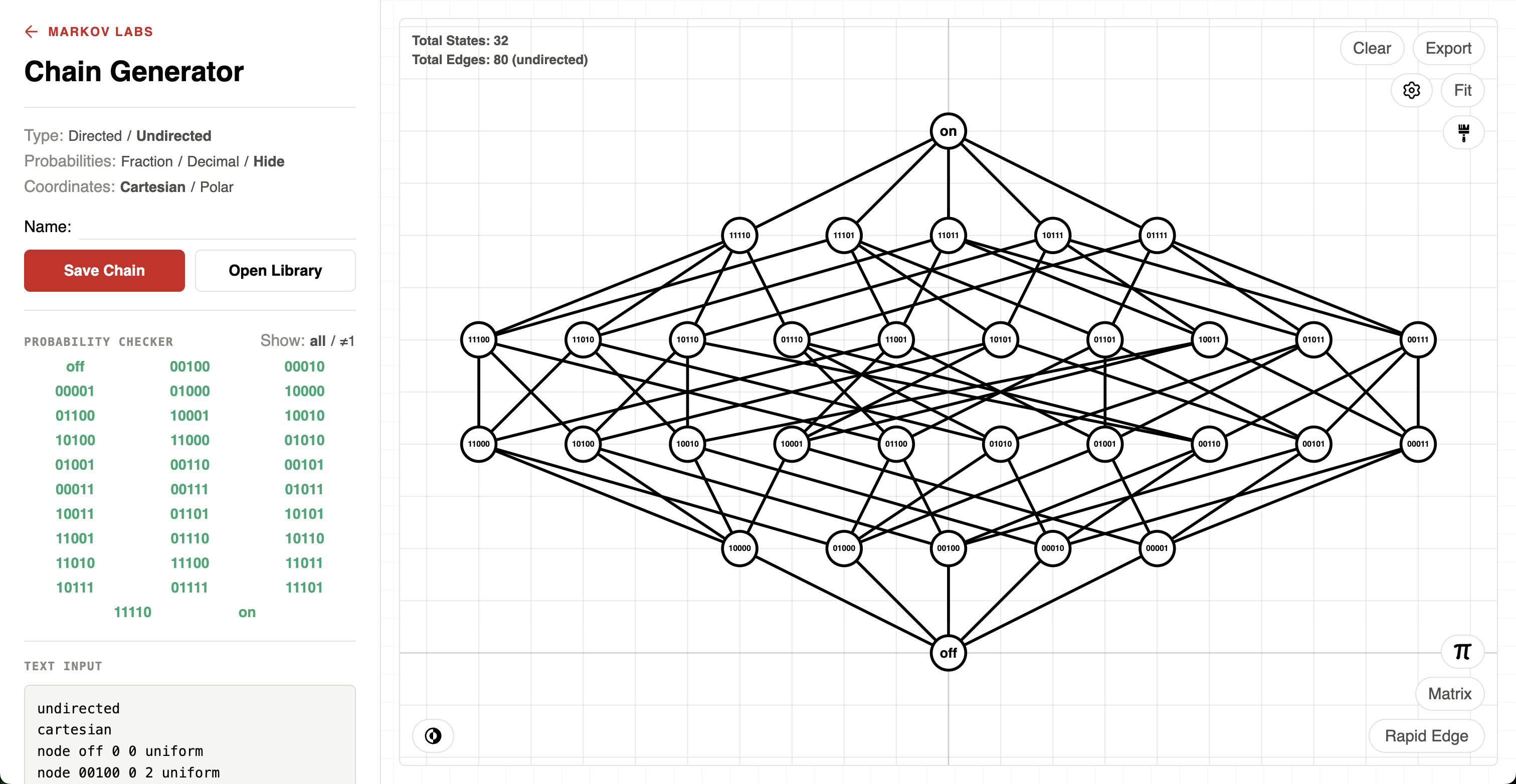
* In an undirected Markov Chain, the stationary mass of a state is proportional to its degree. As seen below, each state in this chain can transition to exactly five other states, each by toggling a single one of its bulbs. As such, every state has a degree of 5, and the stationary distribution is uniform. Given the 25 total states, the expected return time to any given state, including all off, is 32.
TOPICS · EXPLORE · DAILY
Browse by structure, daily rhythm, or what the catalog is surfacing now.
Open organized sections and the problems that belong to each idea.
A clean problem of the day when you want one sharp place to start.
Rotates toward recent activity, low solve rates, and other problems with unusual signal.
CHAIN GENERATOR
Create chains, check transitions, and explore their structure.
Coming soon: Generate stationary distributions and classify communicating classes.
CONTRIBUTE
If you think we made a mistake or have a question you would like us to add, head over to Contribute. Send us a problem worth including, or tell us when something isn’t right.